Picture this. Your accounts team is working off one spreadsheet, your warehouse staff track stock in a notebook or a separate app, and your sales team has their own list of customers somewhere else entirely. Nobody can see the full picture at once, and every report takes hours to put together because someone has to manually pull numbers from three or four places first.
This is the exact situation ERP software exists to fix, and ERPNext has become one of the most talked-about names in this space, particularly among smaller and mid-size companies that want serious business software without paying enterprise-level prices.
In this article, we will break down what ERPNext actually is, what it can do, and how you can figure out whether it makes sense for your business. Just like every other guide on TutsFlow, we are going to explain this in everyday language, without drowning you in technical terms.
What Is ERPNext?
ERPNext is an open source Enterprise Resource Planning (ERP) system. In plain English, it is one platform where you can manage accounting, inventory, manufacturing, sales, purchasing, projects, HR and even your CRM, instead of using ten different apps that do not talk to each other.
It was built by a company called Frappe, and because it is open source, businesses can either host it themselves or use a paid cloud version. This flexibility is a big reason why ERPNext has become popular with companies that want an affordable alternative to giants like SAP or Oracle NetSuite.
Think of it like WordPress, but for running your entire business operations instead of a website. You get a solid core system, and then you can customize or extend it based on what your business actually needs.
Why Do Businesses Need an ERP System Like ERPNext?
Most businesses do not start with an ERP system. They usually begin with a spreadsheet for accounting, a separate tool for inventory, maybe a CRM for sales, and a lot of manual work to connect everything.
This works fine when you are small, but as soon as you start growing, cracks begin to show:
Your inventory numbers in the warehouse do not match what your sales team sees. Your accounting team spends hours reconciling data from other departments. You have no real time view of cash flow, stock levels or order status. Reporting becomes a slow, manual process instead of something you can check instantly.
An ERP system like ERPNext solves this by putting every department on the same platform, using the same data. When a sale happens, your inventory updates automatically. When stock runs low, your purchasing team already knows. Everyone works from one source of truth instead of five different files.
Key Features of ERPNext
ERPNext is built around modules, so you can pick the ones your business actually needs. Here are the core areas most businesses use.
Accounting
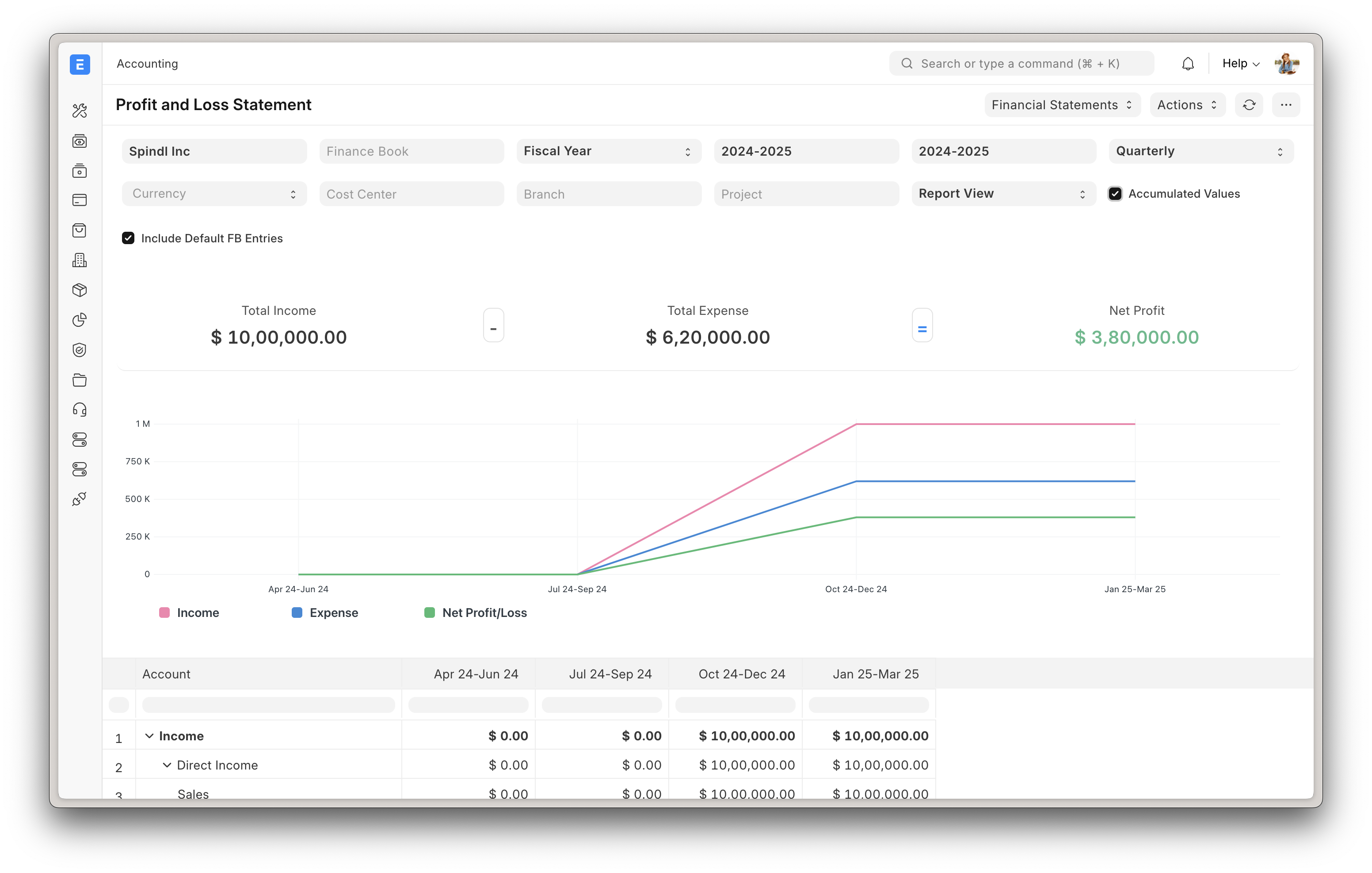
Full double entry accounting, invoicing, expense tracking, financial statements and multi currency support. This alone replaces tools like QuickBooks or Xero for many companies.
Inventory and Warehouse Management
Track stock across multiple warehouses, set reorder levels, manage batches and serial numbers, and get instant visibility into what is available and what needs to be reordered.
Manufacturing
Bill of materials, production planning, work orders and quality checks, which makes it a strong choice for manufacturers who need to track raw materials through to finished goods.
Sales and CRM
Manage leads, quotations, sales orders and customer relationships in one place, so your sales team is not switching between five tools during a single deal.
Purchasing
Handle supplier management, purchase orders and approvals, and connect purchasing directly to your inventory so stock levels stay accurate automatically.
HR and Payroll
Employee records, attendance, leave management and payroll, all connected to the same system your finance team already uses.
Projects
Track tasks, timesheets and project costs, which is especially useful for service based businesses that bill clients by time or milestone.
Who Should Consider ERPNext?
ERPNext tends to be a great fit for the following types of businesses.
Small and mid sized businesses that have outgrown spreadsheets but do not have the budget for enterprise ERP systems. Manufacturers who need production planning and inventory tracking in one place. Trading and distribution companies that manage multiple warehouses and need accurate stock visibility. Service businesses that want project tracking connected to invoicing and accounting. Companies that want an open source solution they can customize instead of being locked into a rigid, expensive platform.
If your business is still small with very simple needs, a basic accounting tool might be enough for now. But once you start managing inventory, multiple departments, or more than a handful of employees, an ERP system starts paying for itself very quickly.
Is ERPNext Difficult to Set Up?
This is usually the biggest concern business owners have, and it is a fair one. ERPNext is a full business system, not a plugin you install in five minutes. Getting the most out of it usually involves a few steps.
Mapping out how your business currently works, so the system can be configured to match your real processes. Migrating your existing data such as customers, products and past transactions. Setting up the specific modules your business needs, since not every company needs every feature turned on. Training your team so they actually adopt the new system instead of going back to old habits.
This is exactly where most businesses either succeed or struggle with ERP adoption. The software itself is powerful, but a good implementation partner makes the difference between a smooth rollout and a frustrating one.
ERPNext vs Traditional ERP Systems
Compared to older, enterprise focused systems, ERPNext usually stands out for a few reasons.
Lower cost, since it is open source and does not require the huge licensing fees traditional ERP vendors charge. Faster implementation for small and mid sized businesses, since it is not built primarily for massive enterprises. Flexibility to customize the system to match your exact workflow instead of forcing your business to adapt to rigid software. An active open source community that keeps improving the platform.
It is not automatically the right choice for every business, but for companies that want strong functionality without an enterprise level budget, it is one of the best options available today.
How to Get Started With ERPNext
If you think ERPNext could be right for your business, here is a simple path forward.
List out the biggest operational problems you are trying to solve right now, whether that is inventory accuracy, accounting chaos, or lack of visibility across departments. Decide whether you want to self host ERPNext or use a managed cloud version, based on your team’s technical comfort level. Talk to an experienced implementation partner who can map your business processes to the system properly, since a rushed setup usually causes more problems than it solves. Start with your core modules first, such as accounting and inventory, then expand into manufacturing, HR or CRM once the basics are running smoothly.
Final Thoughts
ERPNext is one of the strongest options available today if you want a business management system that does not lock you into expensive licensing or rigid workflows. It brings your accounting, inventory, sales, manufacturing and HR into one connected platform, so your team spends less time reconciling data and more time actually running the business.
That said, getting real value from ERPNext depends heavily on how well it is implemented. A system this powerful needs to be configured around your actual business processes, not the other way around.
If you are exploring ERPNext implementation for your business and want to work with a team that understands both the technical and business side of it, our parent company Ilmosys is a good place to start. As experts in business software solutions, the Ilmosys team can help you plan, implement and customize ERPNext around how your business actually works, so you get a system your team will actually use, not just software that sits unused after setup.